
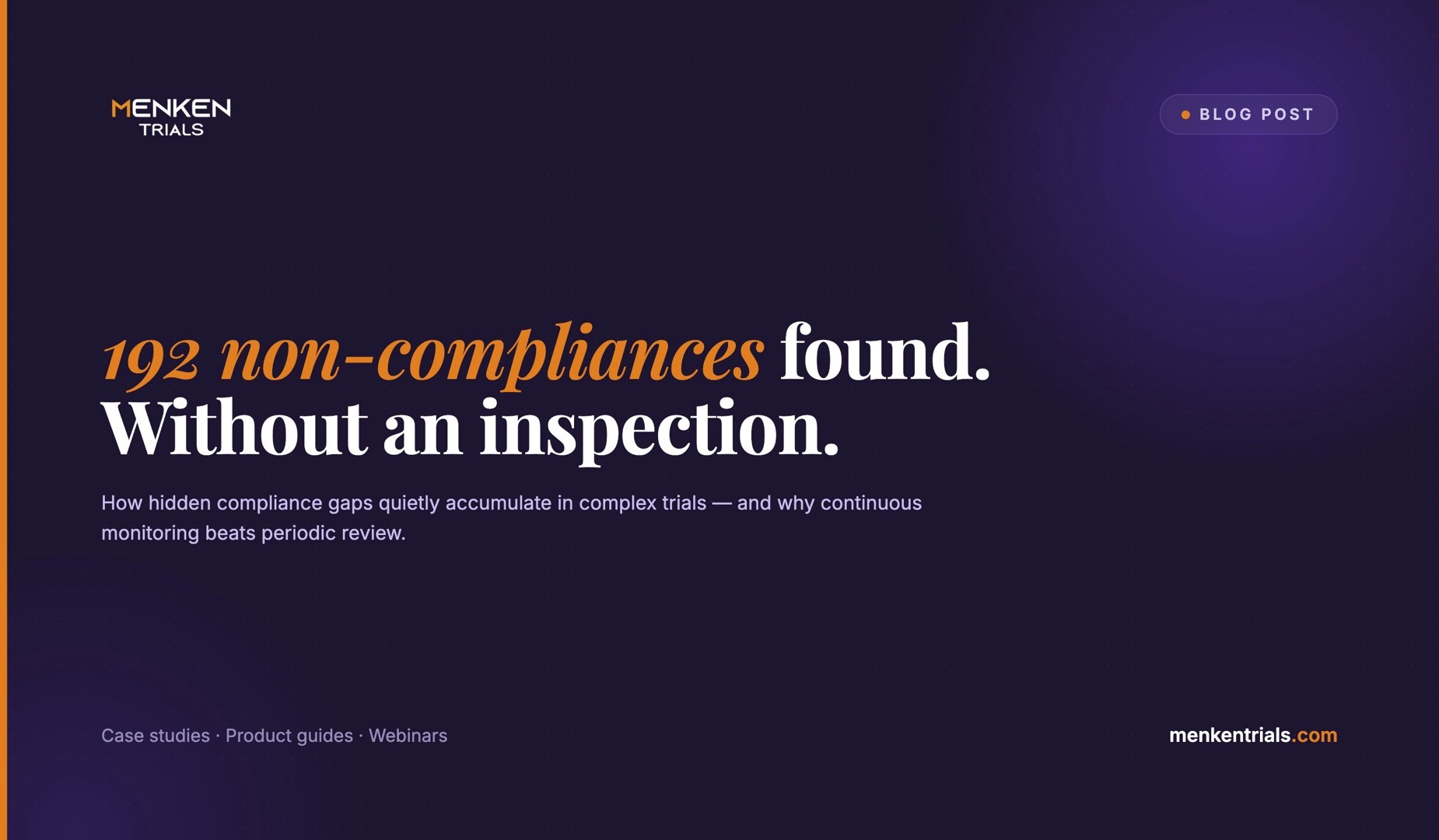
192 non-compliances.
One ongoing clinical study.
No inspection announced. No audit triggered. No crisis visible from the outside.
Everything looked fine.
The study that looked normal
This wasn’t a troubled trial. Multiple parties were involved: a sponsor, a CRO, and several sites. Documentation was spread across different systems owned by different organisations, which is entirely typical in regulated clinical research. Day-to-day work was progressing as expected.
There was no upcoming inspection to prepare for. No notified body review on the calendar. No obvious red flags from the outside.
By most standards, anyone looking at this study would have called it normal.
Within the first nine months of continuous monitoring by Menka AI, 192 non-compliances were identified.
What 192 Non-Compliances Actually Looks Like
These were not dramatic failures. Nobody ignored regulations. Nobody acted in bad faith.
They were the kind of issues that quietly accumulate in complex, multi-party clinical studies and that are rarely visible until someone looks across the entire documentation landscape at once:
- Missing documents: 3 site nurses were delegated laboratory samples shipment, however no corresponding IATA certificate filed.
- No excursion report: The IP was outside of range, without the corresponding IP excursion form
- IB reaching its annual renewal: no indication of any activity to update the IB before “expiration”
- Approval misalignments: documents that had been signed and filed, but there was no supporting regulatory approval.
- Insurance certificate: the site was running close to the number of patients covered by the insurance
None of these issues would necessarily raise alarms on their own. In daily operations, most of them were effectively invisible. That is precisely what makes them dangerous.
Any one of them, discovered during an inspection or notified body review, could trigger a finding, a corrective action plan, or at worst a delay to close-out.
Why These Issues Don’t Get Found
The honest answer is not that clinical teams are careless. Most of the professionals running clinical trials are experienced, diligent, and genuinely committed to compliance.
The answer is that inspection readiness is almost universally treated as something you prepare for, not something you maintain.
In most studies, compliance is assessed through periodic activities: a monitoring visit every six to eight weeks, a central review cycle, an internal audit before close-out. Between those events, documentation accumulates, versions change, personnel rotate, and small misalignments build silently on top of each other.
By the time someone looks, really looks, across the full documentation landscape, the issues that surfaced in one day could take weeks to remediate under time pressure.
The real risk in this study wasn’t a specific document or a specific gap. It was the absence of continuous visibility. Inspection readiness was assumed, not verified.
The Difference Continuous Monitoring Makes
Menken Trials was built around a simple principle: make inspection readiness visible during the study, not during the inspection.
Menka AI runs 500+ compliance checks continuously, not on a schedule, not triggered by a review cycle, but in the background, from the moment a document enters the study. Every document uploaded, every version change, every new delegation entry is assessed against the study’s regulatory requirements in real time.
In the study where 192 non-compliances were found, here is what that meant in practice:
- Issues were identified incrementally, as they emerged, not discovered in a batch before close-out
- Teams were able to address findings as part of normal operations, without the pressure of an impending deadline
- There was no last-minute scramble. No mobilisation of teams under time pressure. No reactive close-out crisis
- By the time close-out arrived, the compliance state of the study was already known and already clean
0 inspection findings. Across every Menken Trials client. Ever.
That result is not luck. It is the outcome of a system designed to make compliance visible throughout the study, not at the end of it.
What This Means for Your Study
Most inspection findings don’t come from dramatic failures. They come from small timing gaps, outdated version references, and incomplete documentation chains, the kind that accumulate quietly in complex studies and are rarely prioritised because they don’t look like problems until an inspector asks about them.
If your current compliance monitoring strategy is built around periodic reviews and pre-inspection preparation, this case study reflects a structural gap, not a performance issue with your team.
The question worth asking is not: “Are we inspection ready?”
The question is: “How do we know?”
If the honest answer involves someone preparing a report, checking a folder, or running a checklist, the answer is: you don’t. Not continuously. Not in the way that prevents 192 issues from accumulating silently in a study that, from the outside, looks completely normal.
See What Menka AI Would Find in Your Study
We offer a 15-minute Menka AI session, no preparation required on your side, no commitment. We run a targeted check against your study documentation and show you exactly what Menka AI surfaces.
Most teams find it clarifying. Some find it uncomfortable. Either way, it is far better to know now than during an inspection.
Menken Trials is a clinical trial compliance platform built by people who have worked in clinical research. Menken Trials provides real-time compliance monitoring for clinical trials through Menka AI.